





If you’ve been watching your traffic dashboards trend red over the past year, you’re not alone, and you’re not doing anything wrong. The internet that marketers built their playbooks on has fundamentally changed, and the old rules don’t apply anymore.
That was the central message from Kyle Denhoff, HubSpot’s Senior Director of Marketing, at our marketing conference this year.
His presentation, “The Loop: How to Thrive with a Little Help from AI,” didn’t just diagnose the problem that many marketers are experiencing. This session laid out a practical AI-powered Loop marketing methodology to address the change that marketers are experiencing.
Here are the highlights.
What Changed in Online Marketing
For nearly two decades, marketers knew how to be successful online: publish SEO-optimized content, rank on Google, and drive traffic to their sites. When organic traffic dipped, it was time to boost paid. When paid became too expensive, it was time to layer in social.
But the old marketing playbook has stopped working.
The culprit was a fundamental shift in how people were finding information online. Google was answering questions itself rather than sending people to websites.
“Nearly six in 10 Google searches now show an AI overview. Google, which used to be the biggest discovery engine in history, no longer sends prospects and customers to your website.” - Kyle Denhoff, HubSpot Senior Director of Marketing
Instead of returning a list of blue-line website links to a query, Google now shows an AI overview first. The result is zero-click searches, in which users often get the answers they are looking for in the AI overview. When that Google AI overview shows up in the search results, the click-through rate drops by more than 50%, according to Denhoff.
Paid media followed a similar trajectory. As organic traffic declined, many marketers leaned into paid channels to compensate, only to find that CPMs were increasing across Meta, TikTok, YouTube, and other platforms.
On social, brand accounts were seeing engagement rates under half a percent, while individual creator accounts were thriving. This change showed that the algorithms were treating brand publishing very differently from human publishing.
Kyle’s top takeaway was that marketing hadn’t stopped working, but the internet had changed. The way people discover, trust, and buy has evolved.
HubSpot saw this change and created a new approach called Loop Marketing.
What Is HubSpot’s Loop Marketing?
Four years ago, HubSpot started focusing on what Kyle called “new media channels,” which included YouTube, podcasts, newsletters, and creator partnerships. Now, more than 55 percent of HubSpot’s content-driven lead demand comes from this people-first content. HubSpot moved from using a linear inbound marketing funnel to a new Loop Marketing framework that could dynamically respond to a multi-channel strategy.
“We’re embedding AI into all of our channels, teams, and systems, and they’re learning every week and making updates as they go. We can move a lot faster.” - Kyle Denhoff, HubSpot Senior Director of Marketing
Where the traditional inbound funnel was linear – awareness to consideration to conversion, one campaign at a time – Loop Marketing creates an “always-on” system that becomes smarter over time.
Loop marketing has four stages: Express, Tailor, Amplify, and Evolve.
The HubSpot Loop Marketing Playbook
| Stage | What It Means | Why It Matters Now |
| Express | Define your brand's voice, taste, and story | AI can scale your brand only if you've defined it clearly |
| Tailor | Personalize every touchpoint using live data | Relevance is the new advantage - personalization is baseline |
| Amplify | Distribute through channels people actually trust | Authority moved from brands to humans; creators drive reach |
| Evolve | Use data and AI to improve in real time | Every campaign teaches the next - speed replaces certainty |
Here’s how each stage works in practice.
Stage 1: Express – Own Your Story
The Express stage is about defining your brand so clearly that no algorithm can define it for you. AI engines are already synthesizing information about your brand and serving it to your prospects. The question is whether you’ve given them intentional material to work from first.
“If you don’t write your story, the algorithm will. Stage 1 makes sure it sounds like you, everywhere.” - Kyle Denhoff, HubSpot Senior Director of Marketing
The work needed for the Express stage shouldn’t be unfamiliar to marketers: brand strategy, messaging frameworks, and style guides. What is different in Loop Marketing is how you use this information. Instead of a static brand profile that sits in a Google Drive folder, your brand guidelines become a “taste profile” that AI can learn and encode in content across all marketing channels.
The HubSpot team builds taste profiles by feeding customer survey data, competitive research, sales transcripts, and leadership workshop data into an AI engine, which helps synthesize a living brand strategy. That strategy then powers the marketing tools HubSpot’s team uses to create collateral, and with a final human quality check, that material is broadcast to the audience.
Stage 2: Tailor – Make it Personal
The second Loop Marketing stage is Tailor, which emphasizes personalized messaging as a competitive advantage. Tailor includes using AI to create communication that can feel like it was written specifically for each prospect.
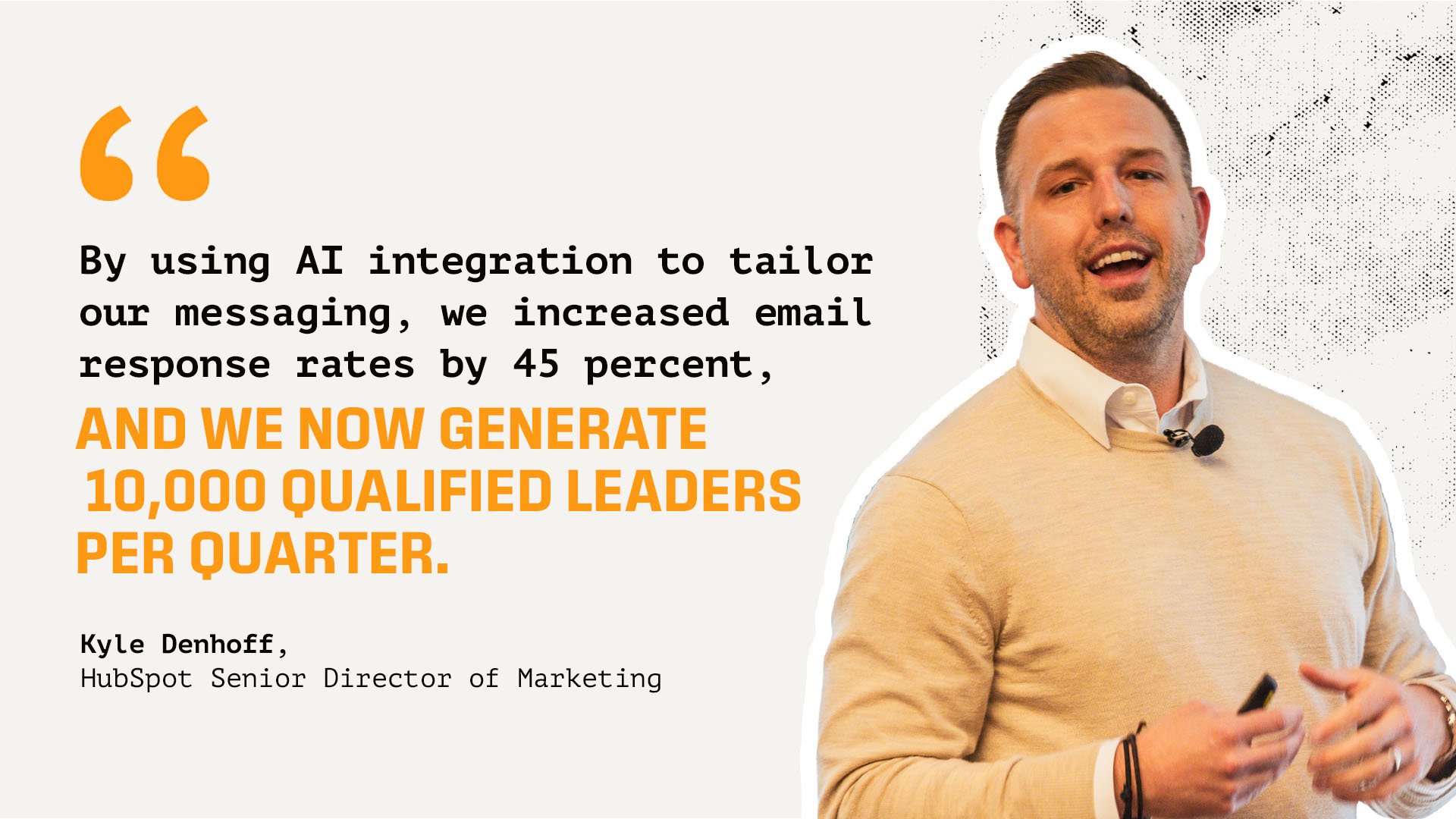
By using AI integration to tailor our messaging, we increased email response rates by 45 percent, and we now generate 10,000 qualified leaders per quarter.” – Kyle Denhoff, HubSpot Senior Director of Marketing
HubSpot built a workflow that enrolls a contact, scrapes their website for context, pulls live CRM signals, and sends that data to an LLM to generate personalized copy that includes specific details and elaboration on likely pain points. This automation doesn’t sound robotic; it sounds natural and as if it were written specifically for the prospect.
Stage 3: Amplify - Go Where the Attention Is
The Amplify stage addresses a disorienting reality in modern marketing: your audience isn’t in one place anymore. The individual audience members could be on YouTube in the morning, listening to a podcast while working out, asking ChatGPT a question during lunch, and scrolling LinkedIn in the afternoon. To reach those customers, your brand needs to show up in all of those places, not just on your website.
“We learned that we needed to change how we are publishing on the web. You’re only seeing about 8 percent of citations now coming from your own website. The answer is to diversify your marketing efforts.” Kyle Denhoff, HubSpot Senior Director of Marketing
HubSpot started using an “anchor and remix” strategy: create a single, authoritative piece of content, then use AI to remix it into different assets for different channels. This effort could include a newsletter excerpt, short social clips, or a blog post.
Deploying this strategy resulted in an 85-percent increase in newsletter and YouTube demand at HubSpot.
Amplify also includes optimizing for AI engines specifically through Answer Engine Optimization (AEO). This approach means writing content that directly answers the questions prospects are asking, but also structuring pages to be AI-reader-friendly.
Stage 4: Evolve - Keep The Loop Running
The final stage in Loop Marketing keeps everything from becoming stale. Evolve is the mechanism that turns campaign cycles into learning loops.
“Integrating AI into this process surfaces what’s working while it’s in market so you can pivot fast, and optimize faster.” Kyle Denhoff, HubSpot Senior Director of Marketing
HubSpot recently released a new performance dashboard, which provides daily insights into marketing efforts, including email open rates, subject-line performance and suggestions on how to increase open rates based on that performance.
The company also released a new, free AEO Grader, which shows how visible brands are inside AI answers. Using the AEO Grader reveals how leading answer engines, including ChatGPT, Perplexity, and Gemini, interpret your brand online. AEO Grader also provides competitive analysis, brand sentiment scoring, and strategic recommendations to optimize your brand’s AI visibility.
Loop Marketing Case Study: HungryHungry
HungryHungry is a hospitality technology platform that provides digital ordering, contactless dining, and payment solutions for restaurants, cafes, and bars.
Previously, HungryHungry Head of Marketing Liz Cherry relied on a quarterly marketing campaign cycle and spent about four hours developing social per week. Any new marketing leads were addressed the next business day.
After integrating the Loop framework, HungryHungry moved from quarterly campaigns to weekly iteration, turning every campaign into a learning engine. The new cycle follows a regular path:
-
Liz sets a strategy each week, defining her campaign goals based on HubSpot CRM data, lifecycle stages, and intent signals.
-
AI then uses this framework to create and execute marketing collateral for the week.
-
Liz is able to review the performance immediately.
-
The lessons learned are then fed back into the AI for further amplification in the following week.
Using Loop marketing, HungryHungry has experienced a 29-percent increase in click-through rates on personalized email videos, a 95-percent weekly workflow reduction, and a 9x engagement lift overall.

The Bigger Picture In Effective Marketing
Kyle’s presentation resonated strongly with his audience, as attendees had experienced exactly what he had described with the marketing shift. While he declared the old marketing playbook obsolete, he provided a new, dynamic alternative.
Loop Marketing provides a new framework for strengthening marketing efforts in the evolving online landscape. But knowing how to put it into practice for your specific business, audience, and goals is another.
Stream Creative helps businesses translate frameworks like Loop Marketing into real strategy. Whether you’re rebuilding your content approach for the AI-powered era, rethinking how to distribute and amplify your message, or figuring out where to start with AEO, we can help.
With our HEXAssessment Analysis, we can show you where your marketing efforts stand today and take the guesswork out of how to create a marketing approach that works in today’s online environment, not yesterday’s. Learn more about Stream Creative and our HEXAssessment Analysis.