

 Author:
Artificial intelligence is fast, but Mike Kaput, Chief Content Officer at SmarterX and co-host of The Artificial Intelligence Show, set his own speed record at Stream Creative’s recent marketing conference.
He delivered one of the most practical sessions of the event: a rapid-fire tour through roughly 40 AI tools that are actively reshaping how marketing, sales, and knowledge workers get things done.
Here’s our take on the AI tools that he covered in his session.
Layer 1: Build Your AI Stack Foundation
Before anything else, Mike said, your AI tech stack should start with a “frontier model” as the technology daily driver: a general-purpose AI capable of handling a wide range of tasks.
“We're all using one or more of these general-purpose, broadly intelligent ‘AI Swiss Army knives’ that can do a lot of different things in a lot of different ways.” - Mike Kaput, Chief Content Officer at SmarterX
The top three foundational AI tools Mike highlighted were:
-
ChatGPT: OpenAI continues to expand this LLM-powered AI application as a broader platform that now includes workspace agents that can execute tasks for users.
-
Google Gemini: Offers superior multimodal capabilities; you can drop a full video into Gemini and have it critique you in ways that aren't yet possible in other tools, and its massive context window means it can hold hundreds of pages of material in working memory without degrading.
-
Claude from Anthropic has a deserved reputation for strong writing and coding performance with increasingly capable autonomous features.
Mike also gave honorable mentions to Grok due to its unique ability to provide real-time sentiment and conversation data from X, and Ollama as an on-ramp to open-source LLM models you can run directly on your own computer. Because these tools run locally, they offer more privacy, offline access, lower costs, and reduce the need to rely on any one AI provider.
Layer 2: Add AI Productivity Tools
Once you have a frontier model as your foundation, Mike suggested adding AI productivity tools to accelerate how you work.
His productivity app suggestions included:
Deep AI Research
Some foundational apps, like ChatGPT and Gemini, include research functionality that allows you to prompt what you want to research and let the tool generate a comprehensive, multi-page brief synthesized from dozens of sources. Mike considers this the most underused tool in his list of 40 and one that will help anyone who manually reads and compiles research.
Grounded AI Research Assistance
NotebookLM from Google is a research and learning assistant that lets you upload a collection of documents, videos, or web pages and then query across all of them. The generated answers are grounded in your sources and footnoted back to the original material. The hallucination risk is significantly lower because it doesn't wander beyond what you've given it.
Custom AI Assistants
Chat GPT and Gemini allow you to build custom AI assistants that require no technical skill to use. In Gemini, custom AI assistants are known as Gems. Mike’s team has built hundreds of custom AI assistants for specific use cases: cleaning up transcripts, writing emails in the brand voice, and formatting reports. Once built, they can be shared across a team, which means one person's ability to get great AI output becomes infinitely replicable.
Workflow AI Assistance
Claude's Projects and Skills let you create sandboxed workspaces tailored to a specific client or use case; Skills are essentially SOPs written in markdown that Claude follows whenever you invoke them. Mike described being able to kick off his entire weekly newsletter process with a single prompt because Claude already knows exactly what to do.
AI Dictation Tools
With most people speaking about four times faster than they type, adding an AI dictation tool can be a tremendous productivity tool. Wispr Flow works across every app on your computer to let you use your voice rather than your fingers.
AI Note-Taking Tools
AI notation is a true convenience, but it also generates natural language data for AI tool use. Mike suggested Granola, Fathom, and Otter for anyone interested in making the digital note-taking jump.
AI-Based Information Retrieval Tools
Rather than relying on web searches, AI-powered retrieval from Perplexity and Google’s own AI-overview search answers provides a synthesized answer with citations. Using these AI-powered apps is a step above the basic Googling most of us do without thinking.
AI-Powered Writing Assistance
While most marketers are already familiar with Grammarly for its editing capabilities, this app now includes newer AI writing and content generation features that Mike suggested the audience also explore.
AI-Powered Presentations
Gamma and Beautiful.ai round out this section as AI-powered presentation-building tools that can turn a prompt into polished slides. Mike says that the output still may need human polish, but these tools signal an evolution from manually building slide decks.
Layer 3: Maximize Your Existing Platforms via AI
One of the most important sections of Mike's talk was not focused on shiny new AI apps. It was a reminder to look at what AI tools you're already paying for.
AI is now built into Microsoft 365 (via Copilot) and Google Workspace across Word/Docs, Excel/Sheets, PowerPoint/Slides, Teams/Meet, and more. Both companies have been moving fast to infuse AI throughout their platforms.
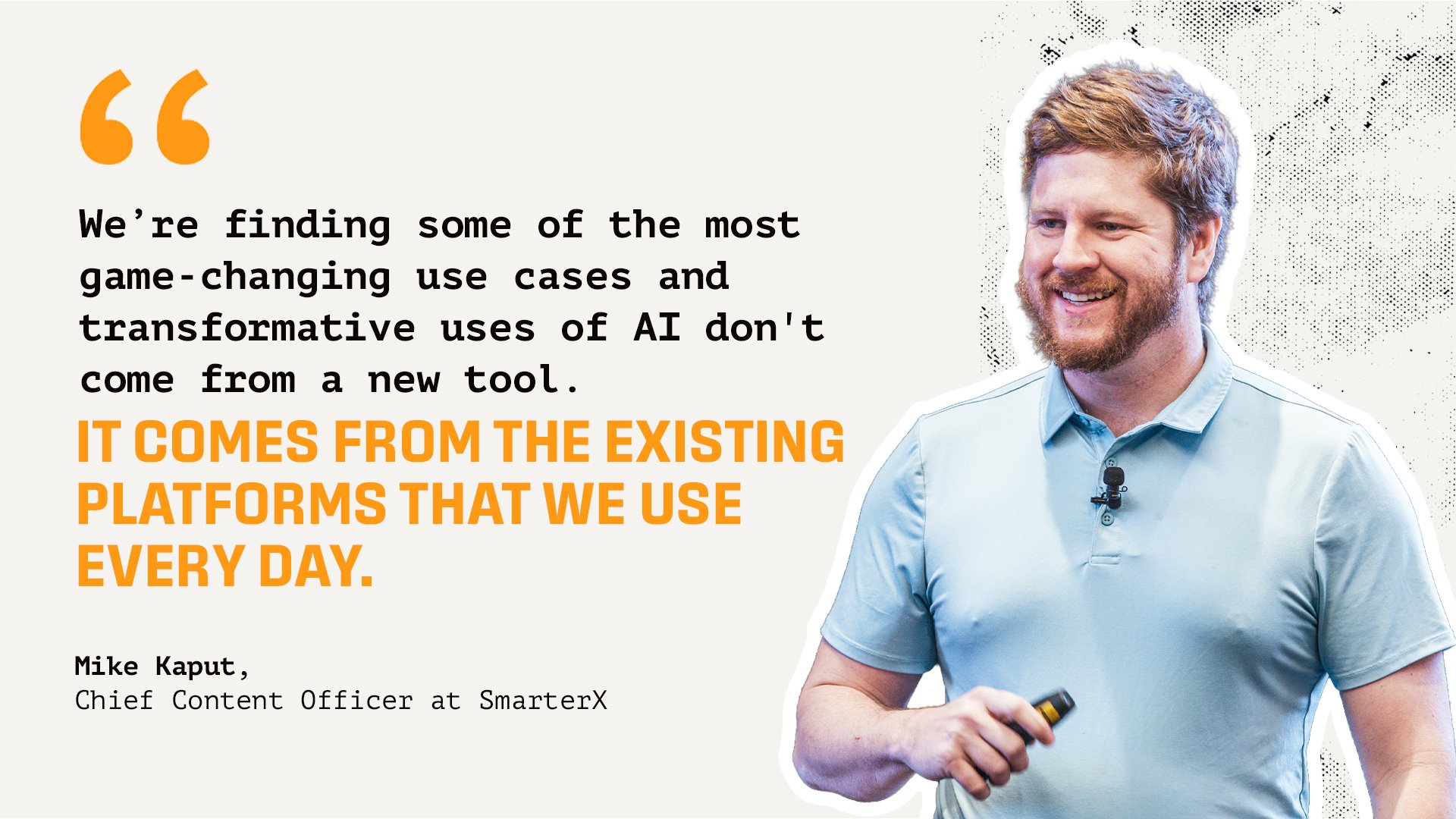
“We’re finding some of the most game-changing use cases and transformative uses of AI don't come from a new tool. It comes from the existing platforms that we use every day.” - Mike Kaput, Chief Content Officer at SmarterX
The same goes for project management tools like Asana and Monday, design tools like Canva and the Adobe suite, and the plugins and connectors that let you link your frontier models to platforms like HubSpot, Google Calendar, and Gmail.
How is HubSpot integrating AI? Read more in our summary of HubSpot’s newest AI integration tools and how they are enhancing users’ marketing efforts.
Layer 4: Agentic AI Tools
Mike’s session then crossed into what he considers the most exciting tools: where AI is crossing over from a chat interface to becoming an autonomous worker.
OpenAI Codex and Claude Code both started as coding agents. Now, these two tools function as general-purpose agents that can look at your computer, use your browser, create files, connect to other tools, and work through multi-step tasks without needing your input at every turn.
Google Workspace Studio and Claude Cowork offer coding abilities for non-technical users. You can point these tools at folders or accounts, describe what you want done, and they do it. Mike described Cowork's name as intentional: we're moving toward AI as something we work with, not just a thing we query.
OpenClaw is an open-source agent that operates 24/7 and can be texted instructions to complete tasks autonomously. However, Mike was transparent about OpenClaw’s security concerns due to its significant system access. He recommended “careful experimentation” rather than a broad deployment to explore its functionality.
Lovable, Bolt, and Google AI Studio are the "vibe coding" entry points where you can describe an app or tool in plain language and watch it get built. For marketers and business leaders, this is worth at least a curiosity visit: it's increasingly possible to build lightweight tools, internal dashboards, or simple workflows without any technical background.
Interested in vibe coding? Make sure to check out the recap from Stream Creative’s own Brian Brinkman, who used his marketing seminar session to show how easy vibe coding can be.
Layer 5: Marketing and Sales-Specific AI Tools
The final category covers point solutions built specifically for marketing and sales work. The tools Mike recommended will enhance specific use-case workflows.
Jasper and Writer are AI platforms built specifically for marketing content, with a focus on learning and maintaining your brand voice. Writer is a good AI tool for regulated industries where compliance matters.
Goldcast is an events and webinar platform. After an event, it automatically generates blog posts, email copy, and short video clips from the recording. Mike’s team uses it as a content multiplier: one webinar becomes dozens of assets with minimal additional effort.
Descript does the same for podcasting and video: all-in-one audio and video editing with AI that makes the work accessible to non-professionals.
Databox layers AI over your analytics data so you can ask performance questions in plain English rather than digging through dashboards. This meaningful shift changes how teams interact with their own numbers.
Webflow has been building website tools for a long time, but what's notable now is its built-in AI search optimization features. This AI integration helps sites surface in LLM responses and eventually in AI agent research, not just traditional search.
Clay uses AI to enrich sales prospect data automatically. HeyGen creates AI avatars that present and lip-sync in 175+ languages, useful for localization and internal training. ElevenLabs does the equivalent for voice by cloning and generating studio-quality speech in 70+ languages.
ReadingMinds was perhaps the most distinctive tool on the list: an AI that conducts voice interviews with your customers and measures not just what they say but how they feel by analyzing tone, hesitation, and sentiment to discover emotional signals that written surveys miss.
OpusClip closes the list by taking long-form video and automatically selects the most shareable short-form clips, with AI predicting which moments are most likely to resonate.
The tools Mike covered span everything from foundational models to autonomous agents, but the throughline is clear: AI is no longer a nice-to-have for marketers. AI tools are rebuilding the infrastructure that knowledge work runs on.
The good news is that Mike encourages cherry picking from his list to find the AI apps that will best enhance your specific workflows. You don't have to adopt all 40 AI tools to make a difference. Start with the layer that matches where your team is now. Lock in a frontier AI model, explore what's already inside the platforms you're paying for, and build from there.
The teams that invest in AI literacy now, and not just provide access to AI tools, are the ones that will accelerate the fastest as AI technology continues evolving.
Stream Creative helps marketing teams understand AI marketing integration and build strategies that actually move efforts forward. Whether you're just getting started with AI or looking to take your stack to the next level, reach out — we'd love to talk.