

 Author:
For the average person, coding and programming have always felt quite out of reach. Coding can be intimidating, and used to require advanced knowledge to attempt successfully.
With the integration of AI and its coding capabilities, Brian Brinkman, partner and co-founder of Stream Creative, is convinced that anyone can now become a coder.
Brian recently introduced vibe coding at an educational session and showed attendees how easy it is to “vibe code” to build micro-apps. In fact, he built one during the session.
Here are the highlights from Brian’s session.
What Is Vibe Coding?
The term vibe coding was introduced by Andrej Karpathy, OpenAI co-founder and former Tesla AI director, in February 2025. It describes how an LLM model, natural language, and basic human curiosity can replace lines of written code.
"There's a new kind of coding I call 'vibe coding,' where you fully give in to the vibes, embrace exponentials, and forget that the code even exists,” Karpathy tweeted.
Vibe coding is a style of coding where you write, debug, and deploy software through natural language instead of manual typing.
Brian defined three prerequisites for anyone interested in vibe coding:
-
A curiosity and a willingness to learn and try something new
-
A deep understanding of a coding language, which can now be spoken and written in natural English
-
The ability to prompt, which has evolved from structured step-by-step algorithmic instructions to more natural conversations with an LLM
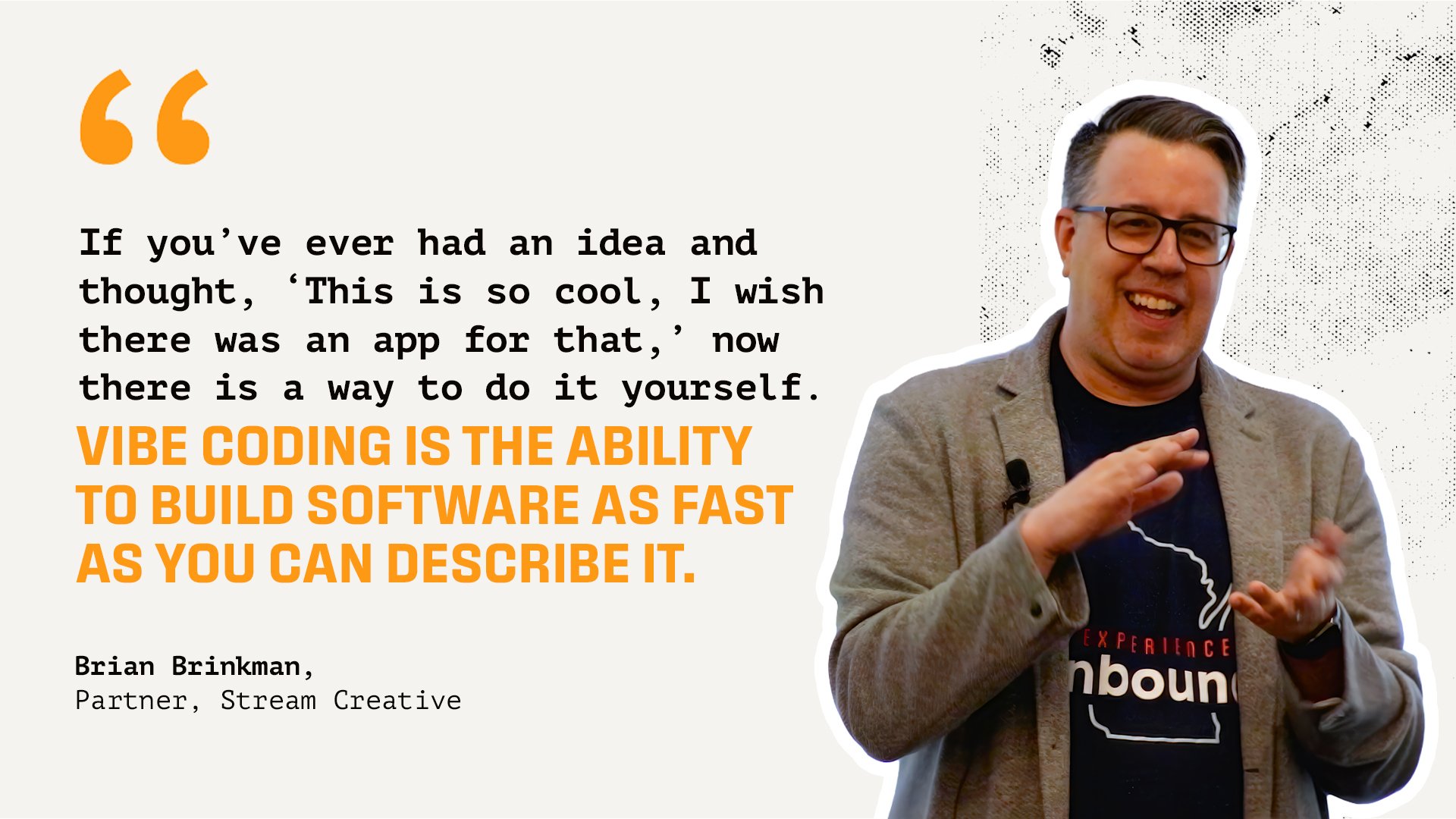
“If you’ve ever had an idea and thought, ‘This is so cool, I wish there was an app for that,’ now there is a way to do it yourself. Vibe coding is the ability to build software as fast as you can describe it.” - Brian Brinkman, Partner, Stream Creative
What makes vibe coding so accessible is that AI takes care of the code, syntax, and technical side; the role of the human has evolved from code writer to editor. Humans apply their taste and knowledge through prompting to refine their app idea, and AI will respond.
Brian then described the wide range of micro-apps that can be created through vibe coding.
What Can You Actually Build with Vibe Coding?
Based on his experience, Brian said the most suitable applications of vibe coding create focused tools where speed beats perfection:
-
Web apps and other tools, including client portals and games
-
Calculators, which can be added to webpages to replace walls of text and give something visitors can interact with, keeping them on-page longer
-
Form automations and productivity tools, including email drafters
-
Data visualizations, including dashboards and reports
-
Presentations, which can be completely built through vibe coding with an outline and feedback
“I’ve used vibe coding to build a dozen tools for our team; they’re small tools, but they provide big gains. I look for opportunities where I am doing things repetitively or things that I don’t like doing, then I think about whether I can build a tool for that to get it accomplished faster. If I can save 15 minutes a day with a tool, I consider that a win.” - Brian Brinkman
One of the most surprising things about vibe coding is that most of the tools required to start are either already available to you or can be easily – and inexpensively – sought out.

Tools You Can Use to Vibe Code
There are several tools that anyone can use to vibe code, but Brian focused on these primary tools to get started:
-
Google Gemini: Requires a Google account, but no further setup, though you must be 18 to use it. Several Google functionalities can be connected via an API to Google AI Studio. If you are using this at work, your administrator may need to turn on access for you.
-
Claude Code: Use for deeper, larger applications that require more of a full-stack approach. Claude Code can handle complex, multi-step builds.
Brian also recommended ChatGPT’s Codex, Lovable, and Raplet. He suggested checking to see what you already may be using in your organization as a starting point. As your apps grow, you will need to connect to APIs, but the cost to continue using them is generally nominal.
“If you have a Gmail account, either for work or business, you already have access to Google Gemini for vibe coding. Using Google Gemini to try vibe coding is faster and easier than you think.” - Brian Brinkman
Examples of Apps Created with Vibe Coding
In addition to creating apps to help with internal and client workflows, Brian has also successfully built many other apps. He shared some examples at the session:
GateReady is Brian’s personal travel app that tells him how long it will take him in any city to get to his gate when traveling by airplane. GateReady was the first app he built, and it is a prime example of “there should be an app for this.”
He went into Google AI Studio and began explaining via prompt what he wanted the app to do, and the AI created it. The timing calculated by the app changes depending on Brian’s location, his transportation mode, if he’s checking a bag, and whether he has TSA Pre-Check.
“There’s certainly an app you can experiment with to make your own life easier. Start with the low-risk things before you try to take over the world.” - Brian Brinkman
SEO Image Optimizer is an app that Brian created to fill a gap internally at Stream Creative. His content team would create content for clients. Once approved by the client, the content would be sent to the project management team for integration into HubSpot. But what would get lost in the middle were the pictures to accompany the content, which caused a pain point. Brian saw this as an opportunity, and he vibe coded a tool that analyzes the image, provides accompanying descriptive text and cropping functionality.
He’s also vibe-coded apps for:
-
The owner of a golf studio who wanted to show availability based on usage and party size
-
Syncing three trade show monitors to run sections of one image concurrently
-
Providing a policy intelligence dashboard pulling from eight data sources across all 50 states, which he was able to present to several members of Congress in Washington, DC
-
Analyzing brand intelligence, content tone, and personas based on any publicly available URL
While these types of applications provide the opportunity to use vibe coding to create a successful app, they can also be used to create something that can be handed over to a developer for further refinement.
Brian then provided guidelines for the safe use of vibe coding. Here’s a quick rundown.
Build Safely: Three Rules Before You Start Vibe Coding
Vibe coding is genuinely accessible, but accessible doesn't mean consequence-free. Before you start building, Brian recommended keeping the following three things in mind:
-
Own the output. AI writes the code, but you're the one deploying it. If something breaks, behaves unexpectedly, or causes a problem for a client or colleague, that responsibility lands with you, not the model. Treat anything you build the way you'd treat any other piece of work with your name on it.
-
Guard the inputs. On free tiers of tools like Google AI Studio, your prompts may be used to improve the model. This access means anything you type in could leave your control. Client data, passwords, confidential strategy, and internal financials should not be uploaded into a free-tier prompt. If you're working with sensitive information, use a paid plan with enterprise-grade privacy, or better yet, keep sensitive data out of the conversation entirely.
-
Watch the meter. Most vibe coding tools charge based on usage: tokens in, tokens out. For simple builds, costs are negligible. But if you're connecting your app to live APIs or building something with high traffic, costs can scale quickly. Know what you're building, estimate what it might cost to run, and set spending limits before you launch.
The practical rule of thumb to learn how to vibe code: start with low-risk ideas such as tools for your own use, internal workflows, or proof-of-concept prototypes. Once you've got something worth scaling, bring in your IT team. They'll have opinions about security, hosting, and integration.
Most of all, always remember that vibe coding is still fundamentally a smart human using specialized tools.
AI can generate syntax. It cannot generate your ten years of industry experience, your understanding of what your customers actually struggle with, or your instinct for what a good solution feels like in your market.
Your own knowledge is the hard part of building something useful, and it’s unique to you. Vibe coding is just a way to express it.
Stream Creative helps businesses turn emerging ideas like vibe coding into real marketing and sales tools. Whether you're ready to build your first micro-app, looking for ways to create more personalized experiences for prospects, or just trying to figure out where AI fits into your strategy, we can help.
With our HEXAssessment Analysis, we can show you where your marketing efforts stand today and take the guesswork out of building an approach that works in today's environment — one where the businesses that move fast and experiment often are the ones pulling ahead. Learn more about Stream Creative and our HEXAssessment Analysis or contact our team to start a conversation today.