




There’s a moment every leader knows all too well.
Your team is moving fast. Meetings are happening. Campaigns are launching. Slack notifications are flying back and forth like a ping pong ball. Everyone looks busy. Productive, even.
And yet… something still feels off.
The messaging isn’t landing. Sales and marketing aren’t quite aligned. Customers are engaging, but not connecting. And somewhere in the middle of all the hustle, your team starts solving symptoms rather than the actual problems.
That’s exactly what Tony Bynum’s Experience Inbound session, Insights to Impact: A Practical Design Thinking Framework for Marketing & Sales Growth, stopped me in my tracks.
Because his approach isn’t about adding more noise, more dashboards, or more “urgent” brainstorm sessions with sticky notes no one looks at again.
It’s about slowing down just enough to understand what the end goal is before you execute.
And honestly? That might be the leadership reset that many teams need right now.

Design Thinking Isn’t Just for Designers Anymore
When people hear “design thinking,” they sometimes imagine beanbag chairs, giant Post-it walls, and someone saying the word innovation seventeen times before lunch.
Tony flips that perception immediately.
He believes traditional marketers are already great communicators. What design thinking adds is the ability to deeply understand customers before building solutions.
That difference matters.
Because when leaders skip the understanding stage and jump straight into execution, they often create what Tony calls “polished marketing that’s hollow at its core.”
Oof. Let that sink in for a second.
That line landed for me because we’ve all seen it happen:
-
Beautiful campaigns that don’t resonate
-
Teams creating content at lightning speed with little strategic clarity
-
Departments operating in silos while assuming everyone shares the same understanding of the customer
Spoiler alert: they usually don’t.
Tony’s framework challenges teams to stop assuming and start observing.
And that shift can completely transform how leaders guide collaboration inside their organizations.
The “Puzzle vs. Mystery” Mindset Shift Leaders Need
One of my favorite concepts from Tony’s session is his distinction between puzzles and mysteries.
A puzzle has an answer. A mystery requires interpretation.
Read that again.
Most organizations treat business challenges like puzzles:
-
Find the right message
-
Pick the right channel
-
Launch the campaign
-
Done
But customer behavior? Team alignment? Brand trust? Innovation?
Those are mysteries.
They require curiosity, conversation, experimentation, and sometimes sitting in ambiguity longer than feels comfortable. (Fun! Terrifying! Character building!)
Tony explains that design thinking gives teams a structured way to navigate those mysteries without spiraling into chaos.
That’s where design thinking becomes incredibly valuable for leaders.
Because the design thinking framework isn’t just about marketing strategy. It becomes a team-building exercise in how people think together. And teams who can think together, now that is gold!
Why The Design Thinking Framework Works So Well for Team Development
Here’s what really stood out to me from Tony’s session:
The design thinking framework helps teams:
-
Align around shared customer insights
-
Build trust through collaboration
-
Create stronger communication between departments
-
Generate and test ideas faster
-
Focus on customer-centered decision-making
This isn’t one of those brainstorming sessions that disappear into Google Drive purgatory.
It’s practical.
And leaders need practical right now.
One of the biggest challenges identified in Tony’s pre-conference survey was “moving quickly without sacrificing strategy.”
That feels incredibly real.
Teams today are under constant pressure to:
-
produce faster,
-
pivot faster,
-
innovate faster,
-
and somehow still maintain alignment and clarity.
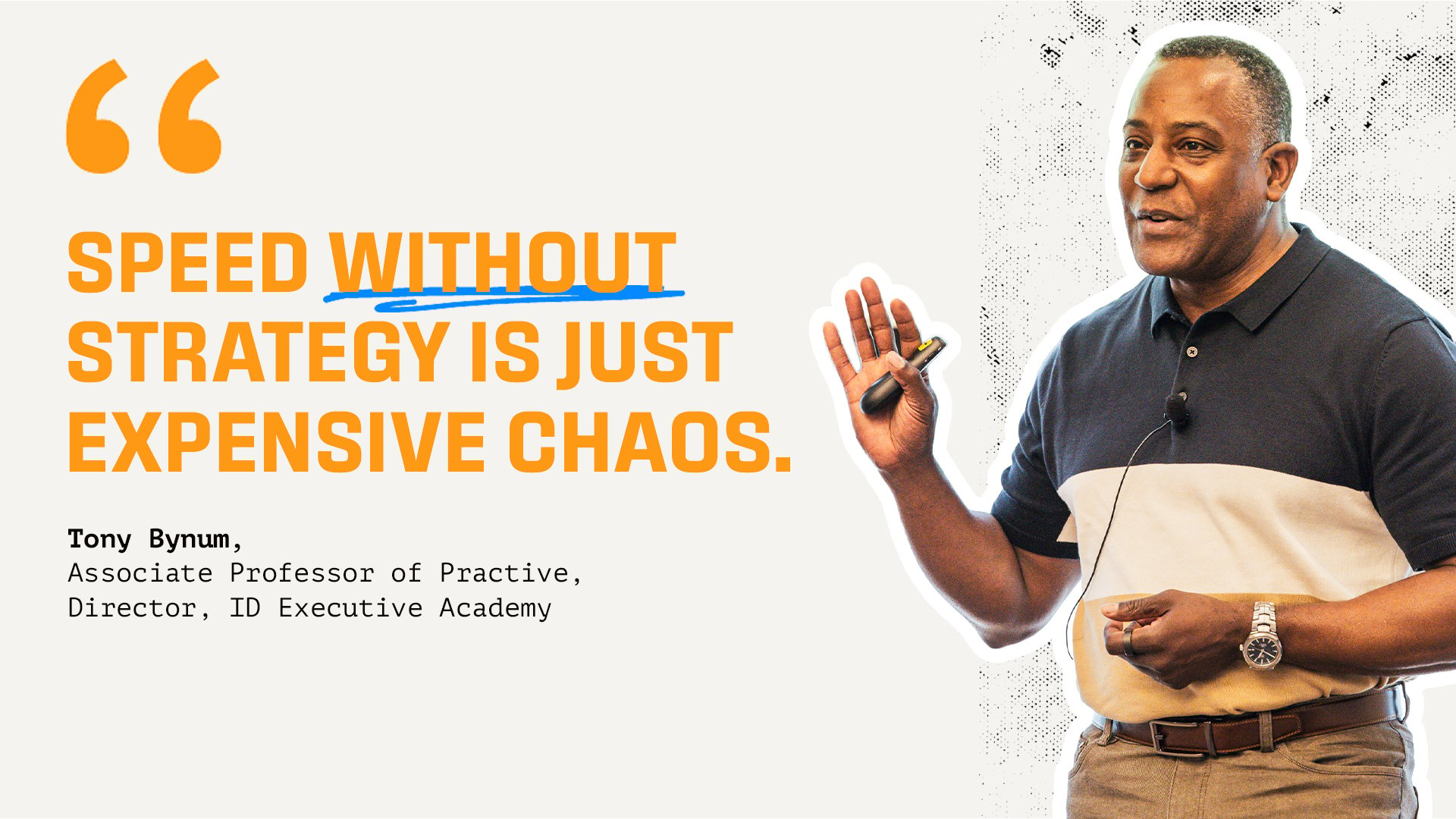
Tony’s response to that pressure is refreshingly grounded: “Speed without strategy is just expensive chaos.”
Honestly, that quote deserves its own coffee mug.
A Team Exercise Leaders Can Actually Use
What I loved most about his session is that leaders can immediately bring these ideas back to their teams.
Tony’s design thinking framework encourages organizations to:
-
Start with empathy and observation
-
Identify real customer pain points
-
Turn observations into actionable insights
-
Brainstorm multiple solutions
-
Test ideas before overcommitting resources
His process naturally fosters stronger collaboration because everyone is working from the same customer truth rather than individual assumptions.
And honestly, there’s something powerful about giving teams permission to be curious again.
Not rushed. Not reactive. Curious.
As Tony shared, “The deepest customer insights don’t live in spreadsheets.”
That line hit me hard because leaders sometimes become so focused on metrics that they end up losing the human element beneath the data.
Design thinking pulls teams back into those human-centered conversations.
Because better strategy usually starts with better understanding.
The Leadership Lesson Hidden Inside All of This
Toward the end of his session Tony shared something I think leaders especially need to hear.
He talked about the difference between change and transition.
Change can feel abrupt.
Uncertain.
A little panic-inducing.
But transition?
Transition acknowledges the journey between where a team is today and where it wants to go tomorrow.
This framing and mindset matters.
Because great leaders don’t just announce change.
They help people move through transition.
And maybe that’s the real beauty of design thinking: It creates space for teams to think together rather than simply react together.
That’s a leadership skill.
A culture skill.
And honestly, a competitive advantage.
A Stand Out Leadership Session at Experience Inbound
Experience Inbound is packed with incredible speakers and tactical takeaways, but Tony’s session offered something different.
It’s not just another conversation about content, AI, or performance metrics.
It’s about how leaders can build smarter teams by understanding people better.
And in a business world obsessed with speed, that feels both refreshing and incredibly necessary.
If your team feels stuck in execution mode…
If collaboration feels fragmented…
If your messaging sounds polished but not fully connected…
Connect with Tony on LinkedIn to learn more about his courses. It might be exactly the reset button your team and marketing strategy didn't realize they needed.
Curious- Where do you get stuck? Data/Findings stage, Insight/observation stage, Brainstorming/Ideation stage? Or Solution/Prototype stage?